How to Choose a Collapsible Gift Box: A 7-Step Buyer's Checklist
By the Xinhongcai Packaging TeamUpdated 20 October 20267 min read
To choose a collapsible gift box, define your product's size and weight first, then pick a structure, materials, finishes, insert and quantity in that order. Each decision affects the next, and sharing all seven with your supplier up front is the fastest route to an accurate quote and sample.
Key takeaways
Start with the product: internal size, weight and fragility decide the structure.
Magnetic and multi-panel structures look the most premium; simpler ones cost less.
Inserts protect the product and set the unboxing feel.
Send quantity, destination and deadline in the first brief to avoid re-quoting.
Gather size, materials and finishes before you brief your supplier.
1. Product size and weight
Measure your product in millimeters (length, width, height) and weigh it. Add clearance for the insert and any tissue or accessories. Very heavy products suit a traditional box more; see collapsible vs traditional rigid box.
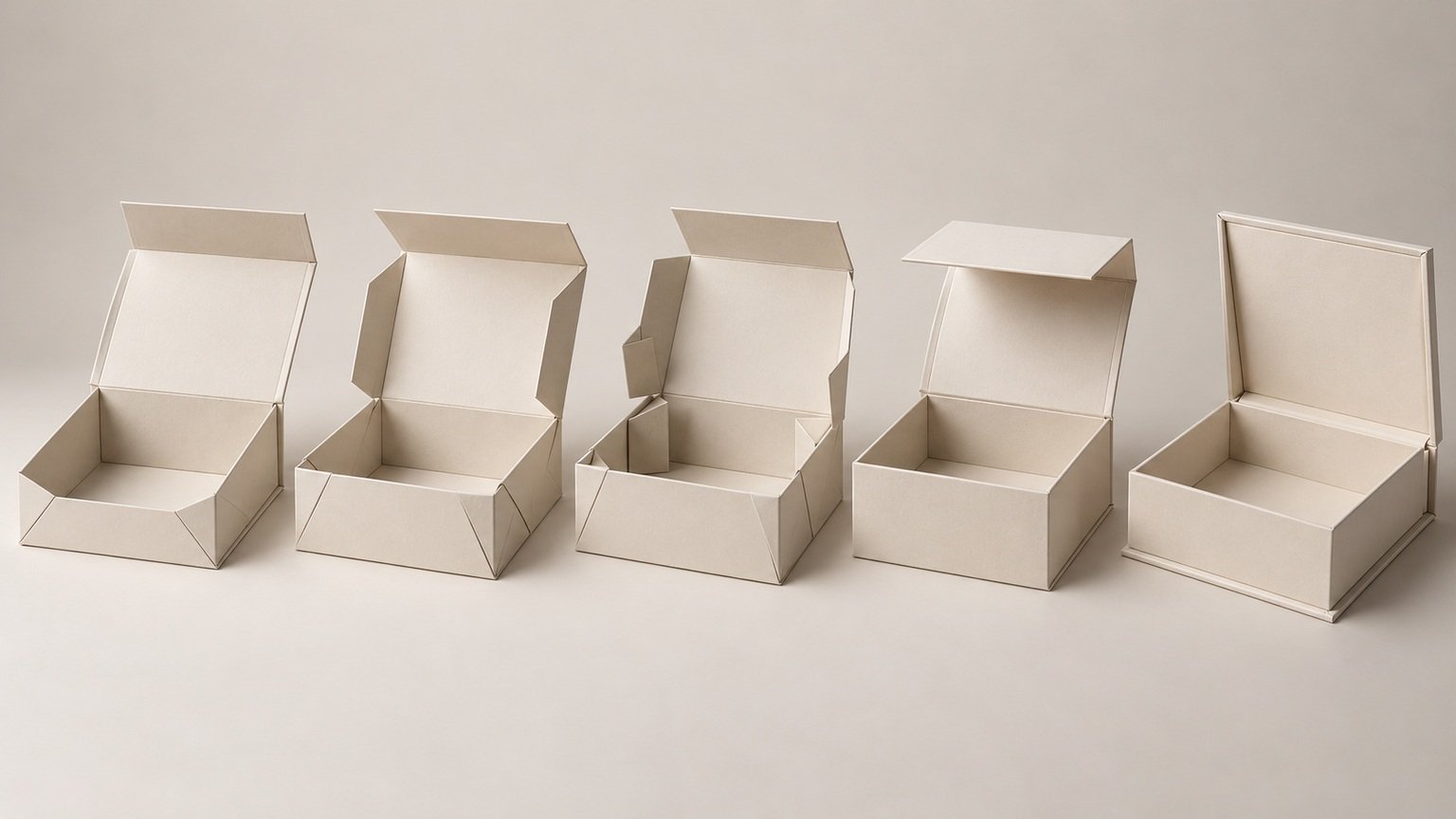
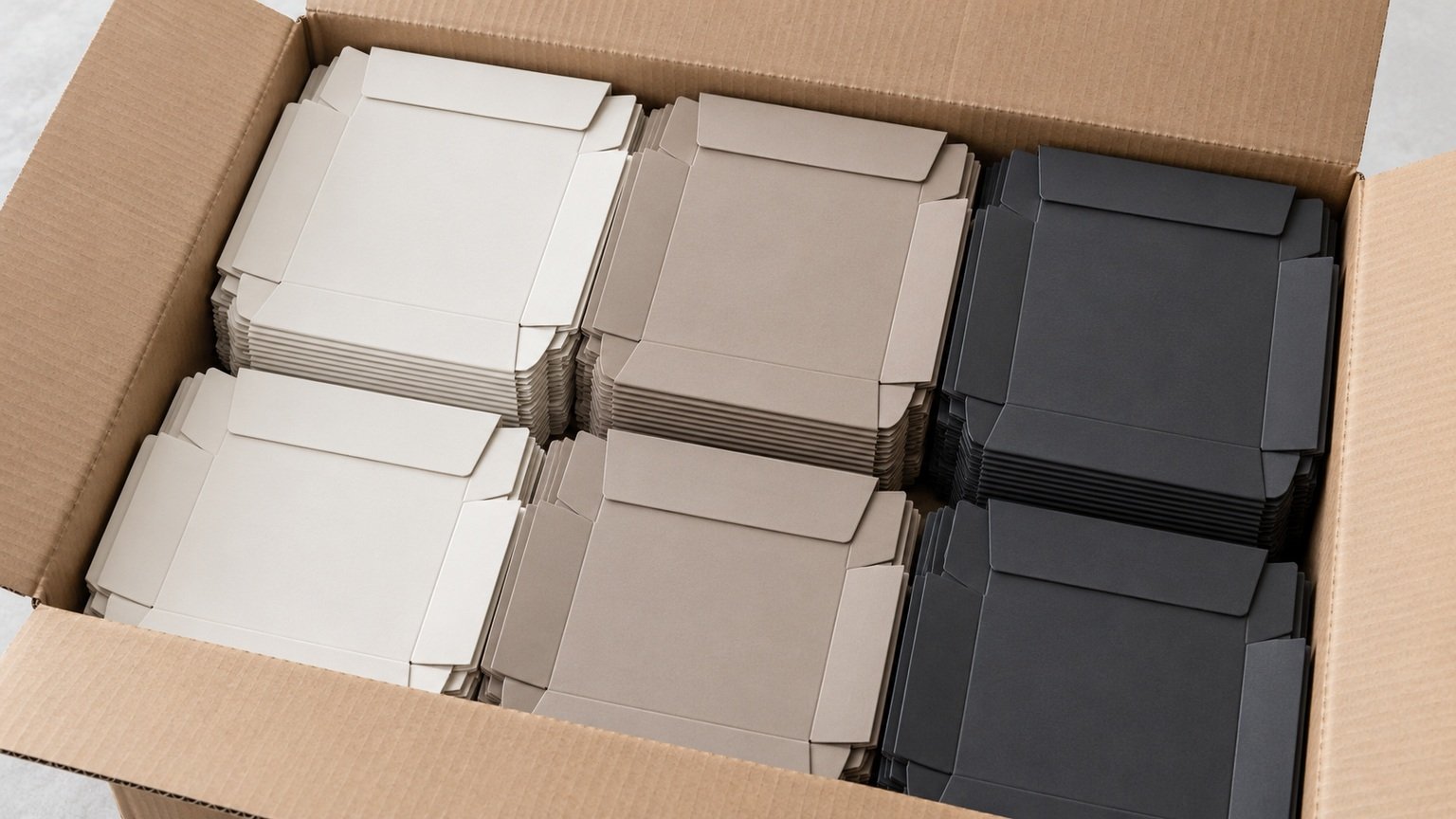
Common collapsible structures: five-, six-, seven-panel and magnetic.
3. Materials
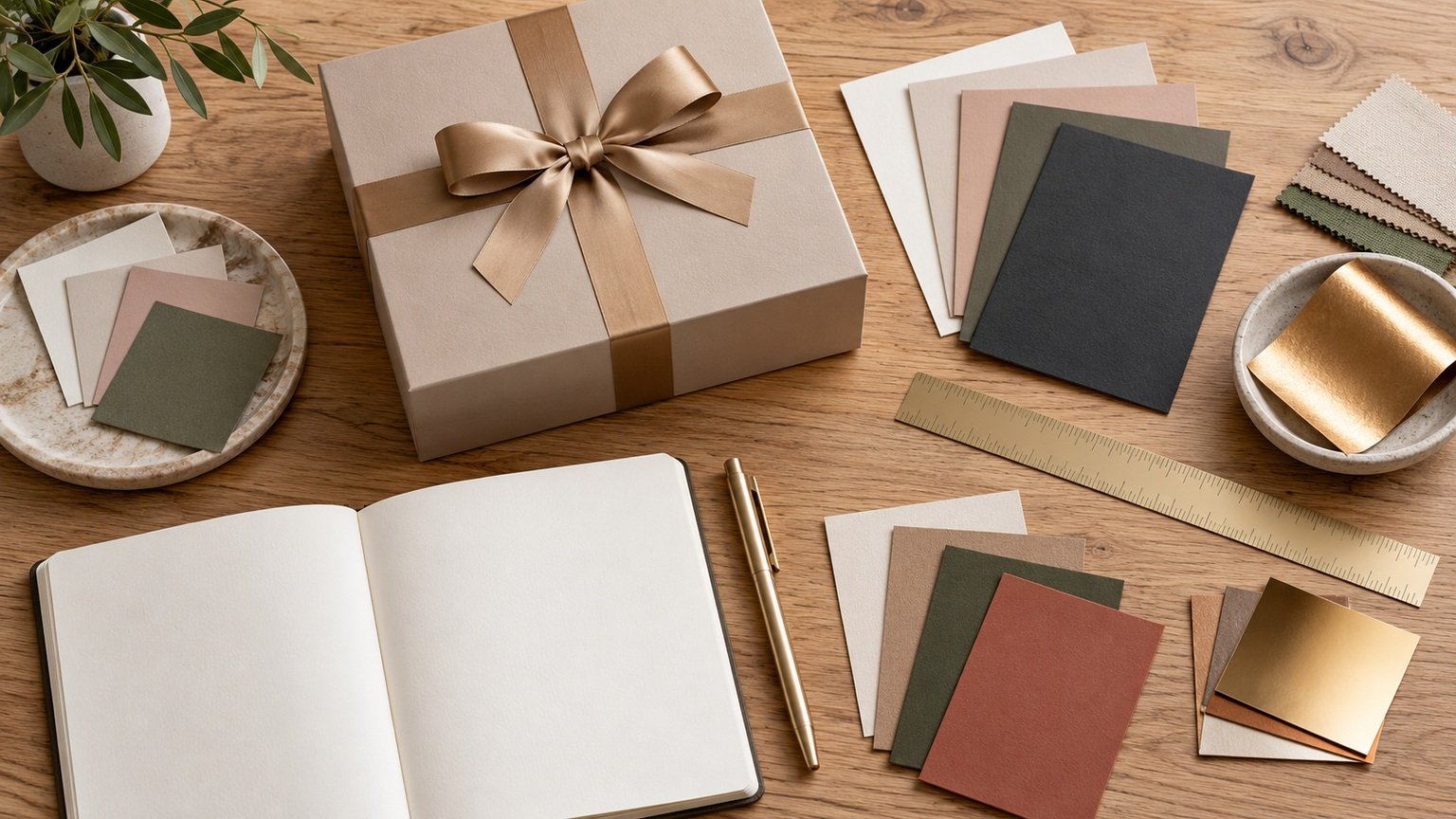
Rigid boxes use thick paperboard wrapped in printed or specialty paper. Choose coated art paper for vivid color, textured paper for a natural feel, or kraft for an eco look. If sustainability matters, ask for FSC-certified paper.
4. Printing and finishes
Matte or gloss lamination: protection and tone.
Hot-foil stamping: metallic logos.
Embossing and debossing: tactile logos and patterns.
Spot UV: glossy highlights on matte surfaces.
Combine two or three finishes rather than all of them; restraint usually looks more premium.
5. Inserts
EVA foam, sponge, EPE, pulp or cardboard inserts hold the product in place. Pulp and cardboard flatten well and are easier to recycle. Read our packaging inserts guide or browse custom packaging inserts.
6. Quantity and timing
Share the quantity per design, number of SKUs and target delivery date. Typical lead time is 10 to 20 working days after sample approval; samples usually take 3 to 5 working days. See production capacity for what we can handle.
7. Write the brief and approve a sample
Send: product size and weight, structure idea, materials and finishes, insert type, quantity, destination and deadline. Approve a physical sample before mass production, and review our quality control process so expectations are clear.
Frequently asked questions
What information do I need to get a quote?
Product dimensions and weight, preferred structure, paper and finishes, insert type, quantity, destination and target date.
Which structure is best for a premium gift?
Magnetic closure or seven-panel structures give the most premium feel, while five-panel is a cost-effective choice.
Can I use my own artwork?
Yes. Send vector artwork or ask for a dieline template and we will confirm print areas.
Do you make samples first?
Yes. A physical sample is recommended before mass production.
Are eco-friendly materials available?
Yes, including FSC-certified paper, kraft and pulp inserts.
How Collapsible Rigid Boxes Reduce Shipping Volume and Freight Cost
By the Xinhongcai Packaging TeamUpdated 20 October 20266 min read
Collapsible rigid boxes reduce shipping volume because they travel flat and are opened only at the destination. A pre-assembled rigid box is mostly empty air, yet carriers charge for the space it occupies. Folded flat, the same box takes up a small fraction of that space, so more units fit in each carton, on each pallet and in each container.
Key takeaways
Freight is charged by the greater of actual weight or volume, so empty space costs money.
Flat-packing lets many more boxes fit per export carton than assembled boxes.
Savings grow with order size, distance and air-freight use.
Always compare landed cost per unit, not just the unit price of the box.
Carriers bill by dimensional weight: if a parcel is bulky and light, you pay for the space it takes rather than its scale weight. Ocean freight is priced per container or cubic meter (see TEU). Rigid gift boxes are bulky and light, which is the worst case for this pricing, so reducing volume is the most direct way to reduce freight.
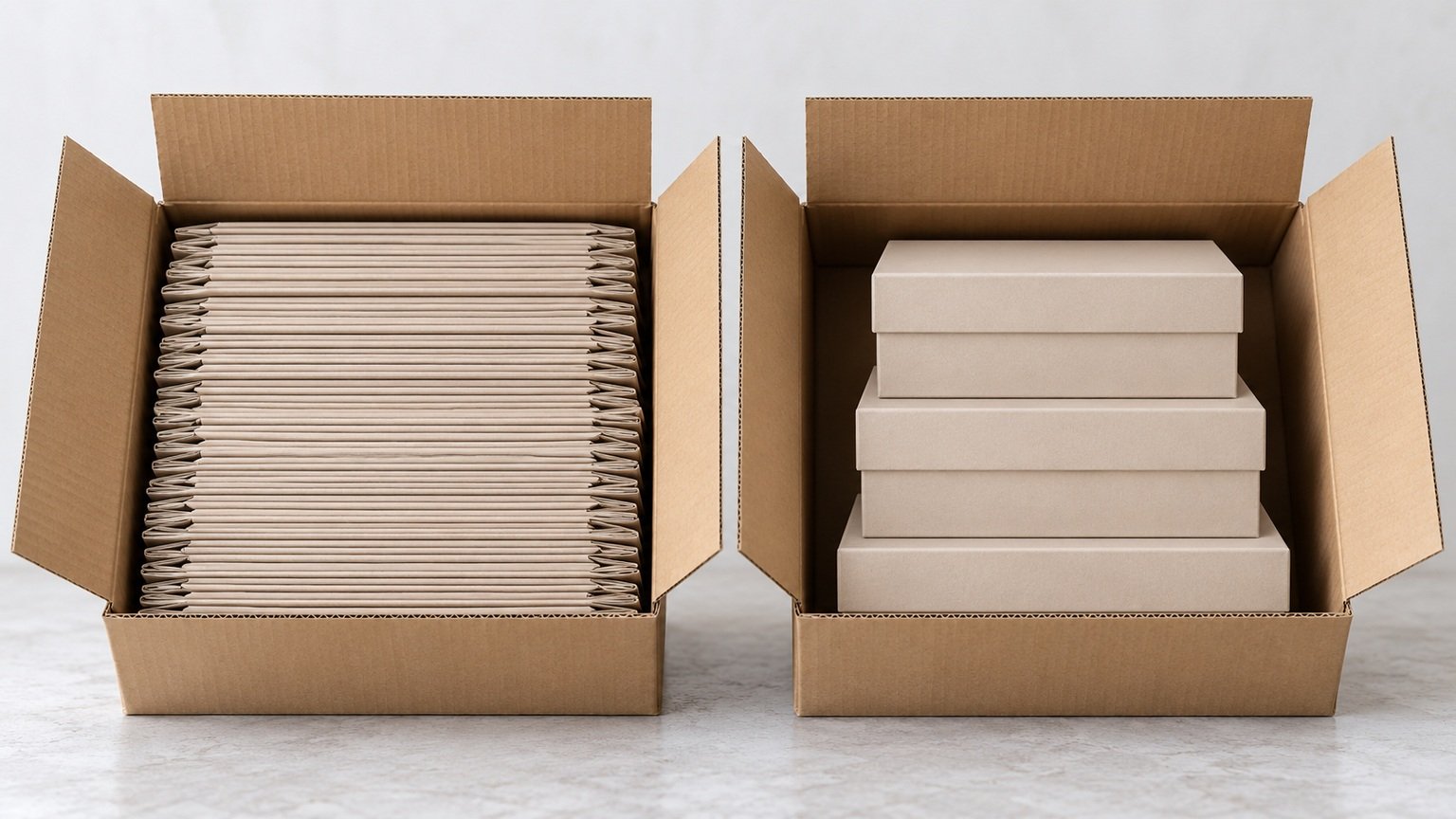
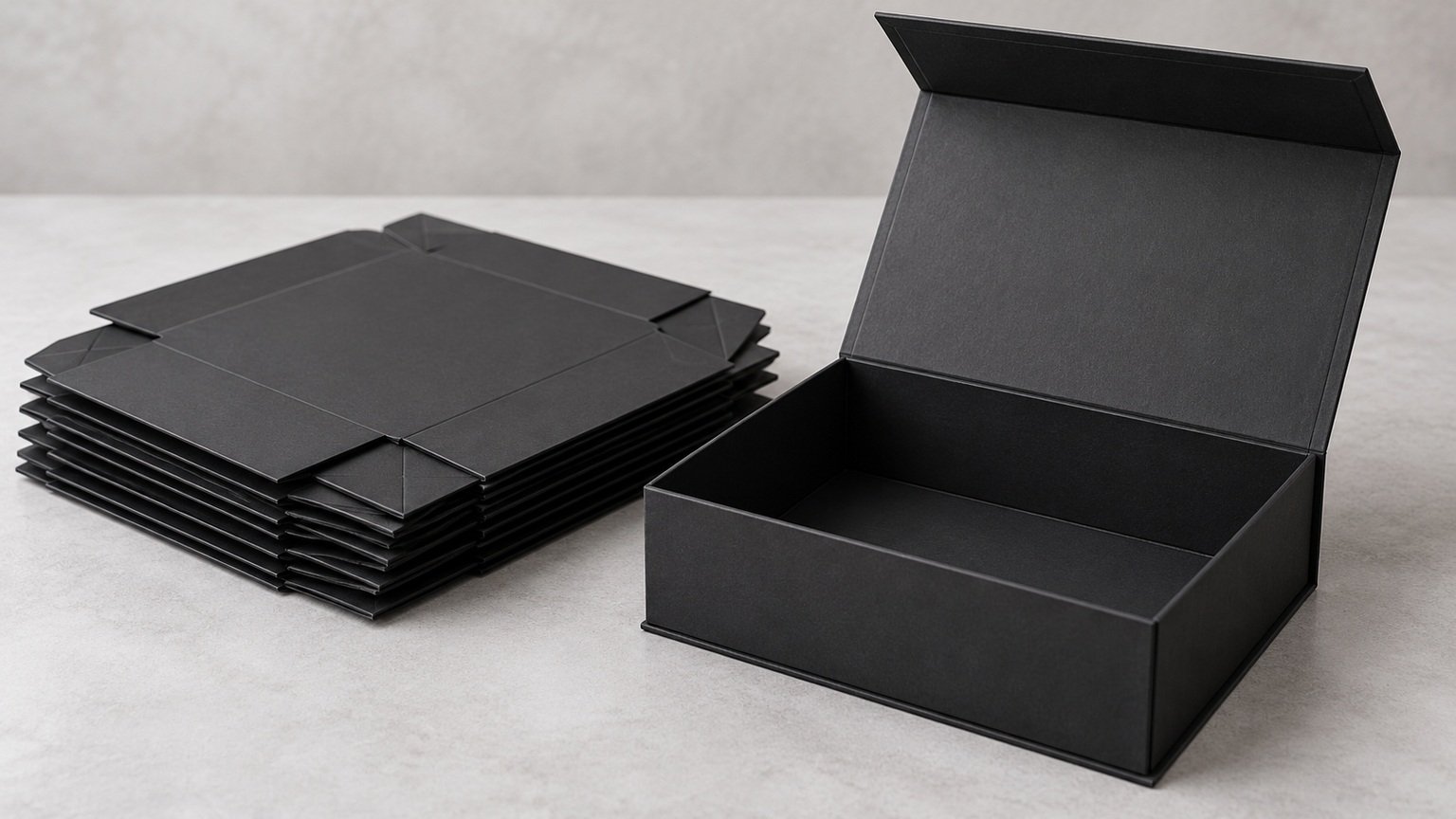
Flat-packed boxes fill an export carton with almost no empty space.
These figures are an illustration of the method, not a quote. The ratio depends on box size and structure.
Item
Assembled rigid box
Collapsible rigid box
Box size (assembled)
25 x 20 x 8 cm
25 x 20 x 8 cm
Volume per box
4,000 cm3
about 500 to 800 cm3 flat
Boxes per 0.1 m3 of carton space
about 25
about 125 to 200
Cartons for 10,000 boxes
many
a fraction
To calculate your own: divide the carton volume by the volume of one packed unit, then divide your freight quote by units per carton to get freight per box. Ask for the flat-pack size and carton size in every quote.
Same carton size, far more boxes when packed flat.
How much can collapsible boxes cut shipping volume?
It depends on size and structure, but a flat-packed collapsible box can occupy a small fraction of the space of an assembled rigid box, so many more fit per carton.
Does flat-packing weaken the box?
No. The box uses the same thick board; it folds at designed hinge lines and locks or closes magnetically when opened.
Is it difficult to assemble on arrival?
No. It opens in seconds without tools or glue, which suits both brand packing teams and end customers.
Is it worth it for small orders?
Savings are greatest on larger quantities and long distances. For very small local runs a traditional rigid box can be as economical.
Can I ship by air with collapsible boxes?
Yes, and the saving is often larger because air freight is charged by volume more strictly.
Collapsible Rigid Box vs Traditional Rigid Box: Which Is Better?
By the Xinhongcai Packaging TeamUpdated 20 October 20267 min read
A collapsible rigid box and a traditional rigid box look equally premium once assembled; the difference is logistics. A traditional rigid box ships pre-assembled and takes its full volume in every carton, pallet and warehouse. A collapsible rigid box ships flat and opens on arrival, so it uses far less space. Which one is better depends on order size, destination, storage and how heavy the product is.
Key takeaways
Choose collapsible when freight, warehouse space or international shipping matter, and for orders of a few thousand units or more.
Choose traditional for very heavy products, very small runs, or when boxes are filled right next to the factory.
Presentation is equivalent: the same papers, foils, embossing and inserts are available on both.
Unit price is often slightly higher for collapsible, but landed cost is often lower once freight and storage are counted.
A traditional rigid box (set-up box) is glued into its final shape at the factory using thick paperboard or greyboard wrapped in printed paper. It is very sturdy and has been the standard for luxury packaging for decades. Because it is already 3D, it ships and stores at full volume. Our lid and base boxes and drawer boxes are examples of this format.
Comparing only the unit price can be misleading. A useful comparison is landed cost per unit: box price plus freight, duties, warehousing and handling. Because a collapsible box occupies a fraction of the volume, freight and storage per unit fall sharply, which usually outweighs a small unit-price premium on larger orders. A rough way to test it: ask both quotes with the number of units per carton and the carton size. Divide freight by units to see the real difference. Our guide to reducing packaging shipping costs walks through the calculation. Shipping terms such as FOB, EXW and DDP also change what is included; see Incoterms for definitions.
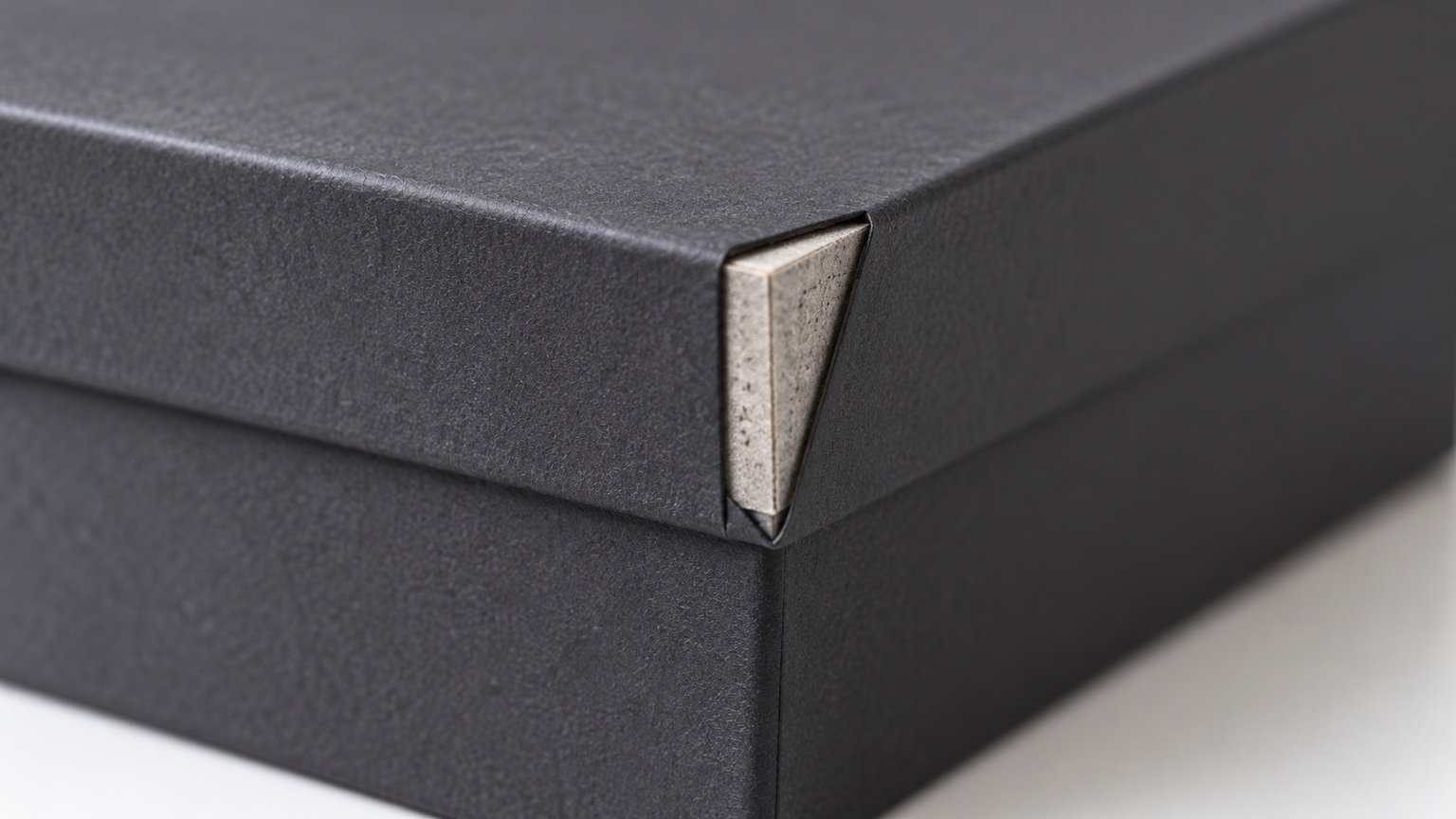
Thick board and wrapped corners give rigid boxes their strength.
Strength and durability
Both use thick board, and for typical gift sets, cosmetics, electronics accessories, tea or chocolate the collapsible structure is strong enough for transit inside an outer carton. For very heavy items (for example, large glass bottles in multi-packs) a fixed rigid box has no hinge lines and carries load more evenly. If you are unsure, we can build a sample and test it with your product before mass production.
How to choose
Order size: a few thousand units or more favors collapsible; very small runs may favor traditional.
Destination: overseas sea or air freight favors collapsible.
Fulfillment: if you pack by hand and need speed, both work, but flat storage keeps the packing bench tidy.
Still undecided? Send your product size, weight, quantity and destination and we will recommend a structure.
Frequently asked questions
Is a collapsible rigid box cheaper than a traditional rigid box?
The unit price is often slightly higher, but the landed cost is often lower on larger orders because freight and storage volume are much smaller.
Does a collapsible rigid box look less premium?
No. It uses the same board, papers and finishes as a traditional rigid box, and once opened it is hard to tell the difference.
Which is stronger?
A traditional rigid box is slightly stronger because it has no fold lines, which matters for very heavy products. For typical gifts and cosmetics, collapsible boxes are strong enough.
Can both have magnets, ribbons and inserts?
Yes. Magnetic closures, ribbons, windows and fitted inserts are available on both formats.
What is the minimum order quantity?
Luxury rigid boxes typically start from 200 to 1,000 units per design, depending on structure.
How fast can I get samples?
Samples typically take 3 to 5 working days after artwork is finalized.
Why Choose Collapsible Rigid Boxes? 7 Benefits for Brands
By the Xinhongcai Packaging TeamUpdated 20 October 20268 min read
A collapsible rigid box is a premium gift box made from thick rigid board that folds flat for shipping and storage, then opens into a sturdy, fully finished box in seconds. Brands choose it because it gives the look and feel of a traditional rigid box while cutting freight volume, warehouse space and handling effort. This guide explains the seven main benefits, what they mean in practice, and when a collapsible box is not the best fit.
Key takeaways
Collapsible rigid boxes ship and store flat, so far more units fit in each carton, pallet and container.
Presentation is not compromised: printing, foil, embossing, specialty papers and fitted inserts all work as on a traditional rigid box.
The biggest savings appear on larger orders, sea freight and long storage periods.
Common structures are five-, six- and seven-panel boxes, magnetic boxes, handle boxes and suitcase-style boxes.
Typical lead time is 10–20 working days after sample approval; samples take about 3–5 working days after artwork is final.
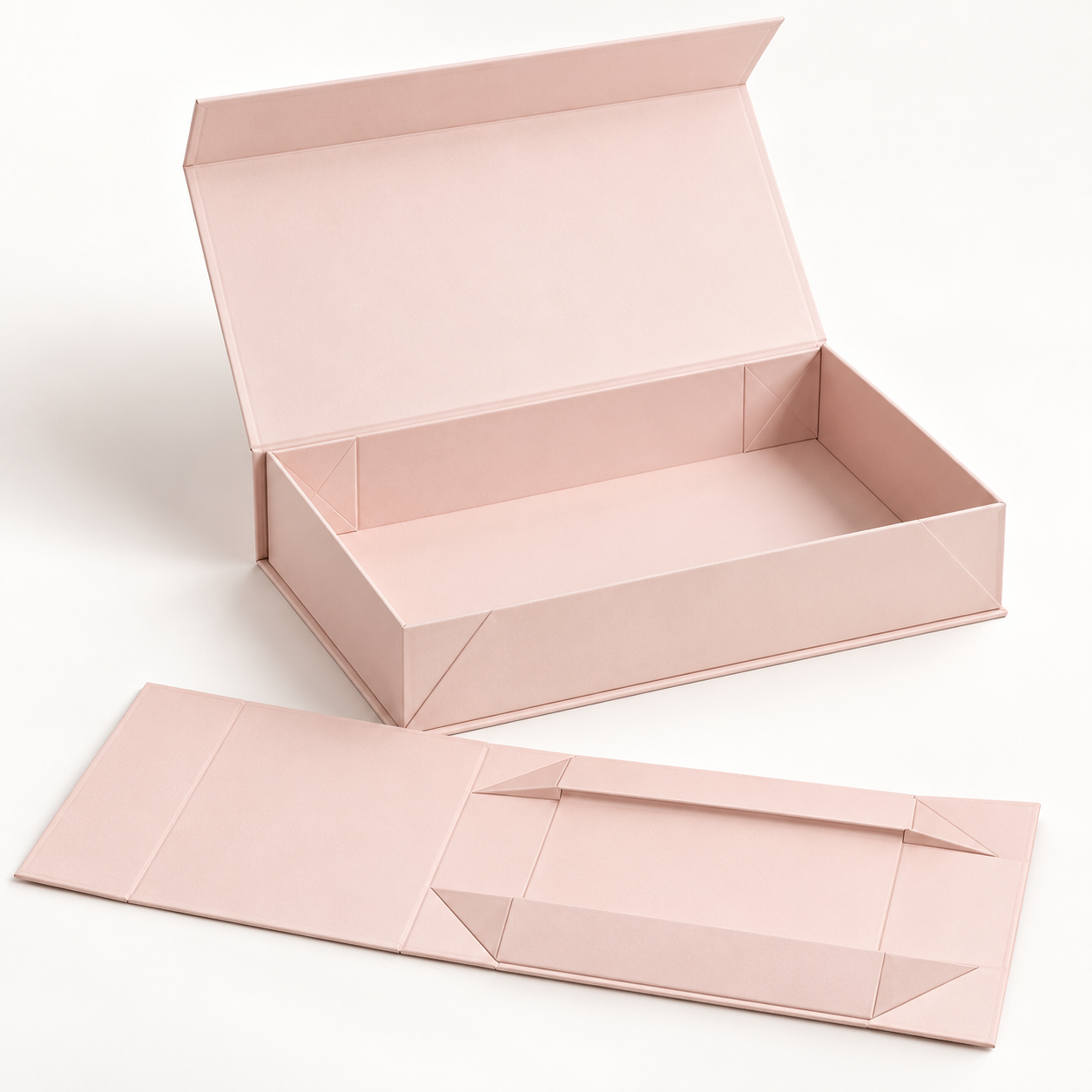
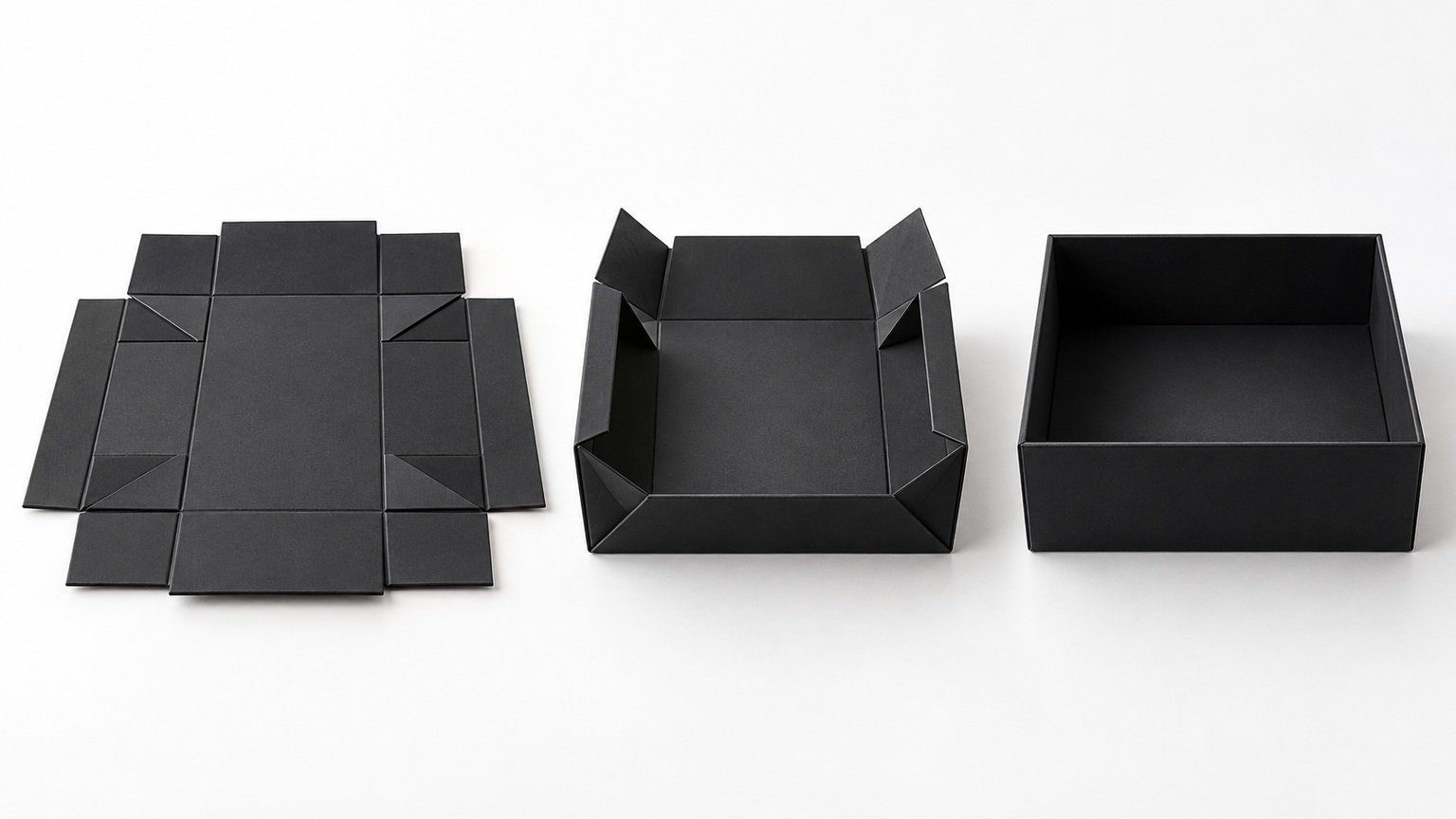
A collapsible rigid box (also called a foldable rigid box or flat-pack gift box) is built from the same type of thick greyboard used in traditional rigid boxes. The difference is in the construction: hinged panels let the box fold flat, and the wall panels lock or snap into position when opened. The outside is wrapped in printed or specialty paper, so the finished box looks and feels like a premium rigid box.
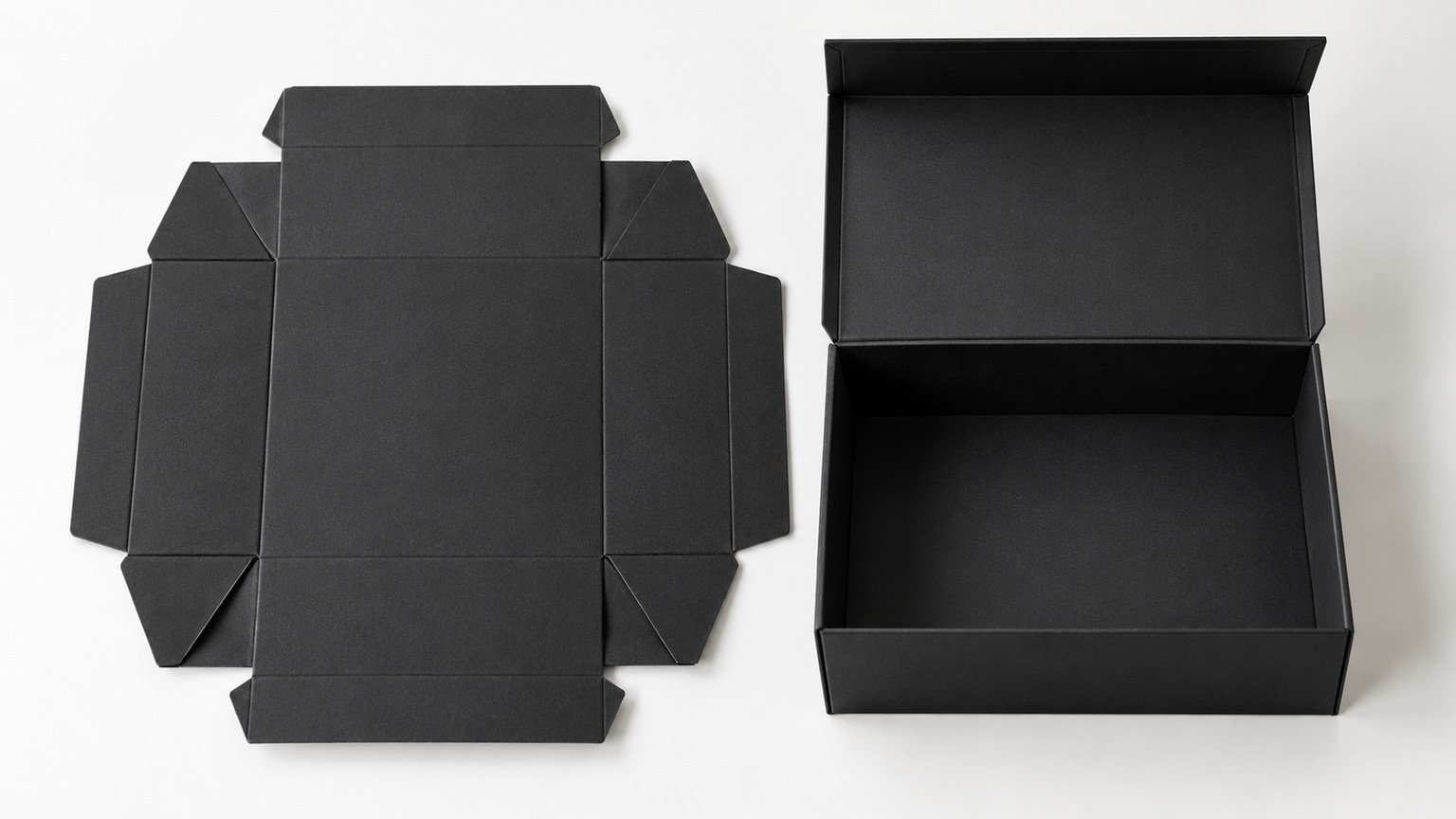
Collapsible rigid boxes ship flat and open into a full rigid box.
Seven benefits of collapsible rigid boxes
1. Lower shipping volume and freight cost
Freight is charged by volume or weight, whichever is greater. A pre-assembled rigid box is mostly empty air, so you pay to ship space. A collapsible box folds to a fraction of its assembled height, so many more units fit in each export carton and each container. Fewer cartons means lower freight cost per unit, especially on sea freight. Carriers also apply dimensional weight pricing for air and express shipments, which rewards compact packaging. We cover this in detail in How Collapsible Rigid Boxes Reduce Shipping Volume.
2. Smaller warehouse footprint
Packaging stock can quietly consume pallet positions. Flat storage lets you hold the same quantity in a fraction of the space, which matters for seasonal campaigns, subscription programs and brands with many SKUs. See our practical guide to optimizing packaging warehouse space.
3. Premium presentation is preserved
Because the box is wrapped in the same papers and finished with the same techniques, nothing is lost on the shelf or in the unboxing moment. Options include offset printing, hot foil stamping, embossing and debossing, spot UV, soft-touch lamination, textured or kraft papers, ribbons and magnetic closures.
4. Faster, simpler fulfillment
Opening a collapsible box takes seconds and requires no tools or tape. For gift sets, influencer kits and e-commerce orders, that means faster packing and fewer assembly errors. Compare this with traditional rigid boxes, which arrive assembled but take far more space everywhere in the chain.
5. Reusable and keepsake value
Customers keep and reuse a sturdy collapsible box, and it can be folded flat again for storage. A box that stays in the home keeps your brand visible long after the product is used.
Less transport volume means fewer cartons and fewer shipments for the same quantity. Paper-based inserts, FSC-certified paper and soy-based inks are available. Our factory holds ISO 9001, ISO 14001, FSC and amfori BSCI certifications and has completed a SMETA audit. For background on packaging regulation and sustainability, see the European Commission's page on packaging waste.
Collapsible vs traditional rigid boxes at a glance
Collapsible boxes are not ideal for every project. Very small quantities may not recoup the extra tooling and construction cost. Very heavy products, or boxes that must carry significant weight without any outer carton, may need a fixed rigid structure. And if your fulfillment team never stores or ships packaging empty (for example, boxes are filled at the factory next door), the flat-pack advantage is smaller. If you are unsure, send us your product size, weight and quantity and we will recommend a structure.
How to order a collapsible rigid box
Brief: share product size, weight, quantity and destination.
Structure and design: we recommend a structure and prepare a dieline.
Sample: a physical sample typically takes 3–5 working days after artwork is finalized.
Production: typically 10–20 working days after sample approval, with checks at every stage described in our quality control guide.
Shipping: FOB, EXW or DDP, confirmed with your quotation.
A collapsible rigid box is a gift box made from rigid board that folds flat for shipping and storage and opens into a stable, premium box. Common structures include five-, six- and seven-panel designs.
Are collapsible rigid boxes as strong as traditional rigid boxes?
For most gift, beauty and electronics products, yes. They use thick greyboard and a locking or magnetic structure. For very heavy products we may recommend a fixed rigid structure.
Do collapsible rigid boxes cost more?
The unit price is often slightly higher because of the extra construction work, but landed cost is frequently lower on larger orders because freight and storage volume drop significantly.
Can collapsible boxes use magnets and ribbons?
Yes. Magnetic closures, ribbons, pull tabs and handles are all available, along with foil, embossing and spot UV.
What is the minimum order quantity?
It depends on structure. Luxury rigid boxes typically start from 200 to 1,000 units per design. Contact us with your design for an exact figure.
How long does production take?
Samples take about 3–5 working days after artwork is finalized, and production typically takes 10–20 working days after sample approval.
Can I add custom inserts?
Yes. We make EVA, sponge, EPE, blister, paper pulp and cardboard inserts cut to your product.