
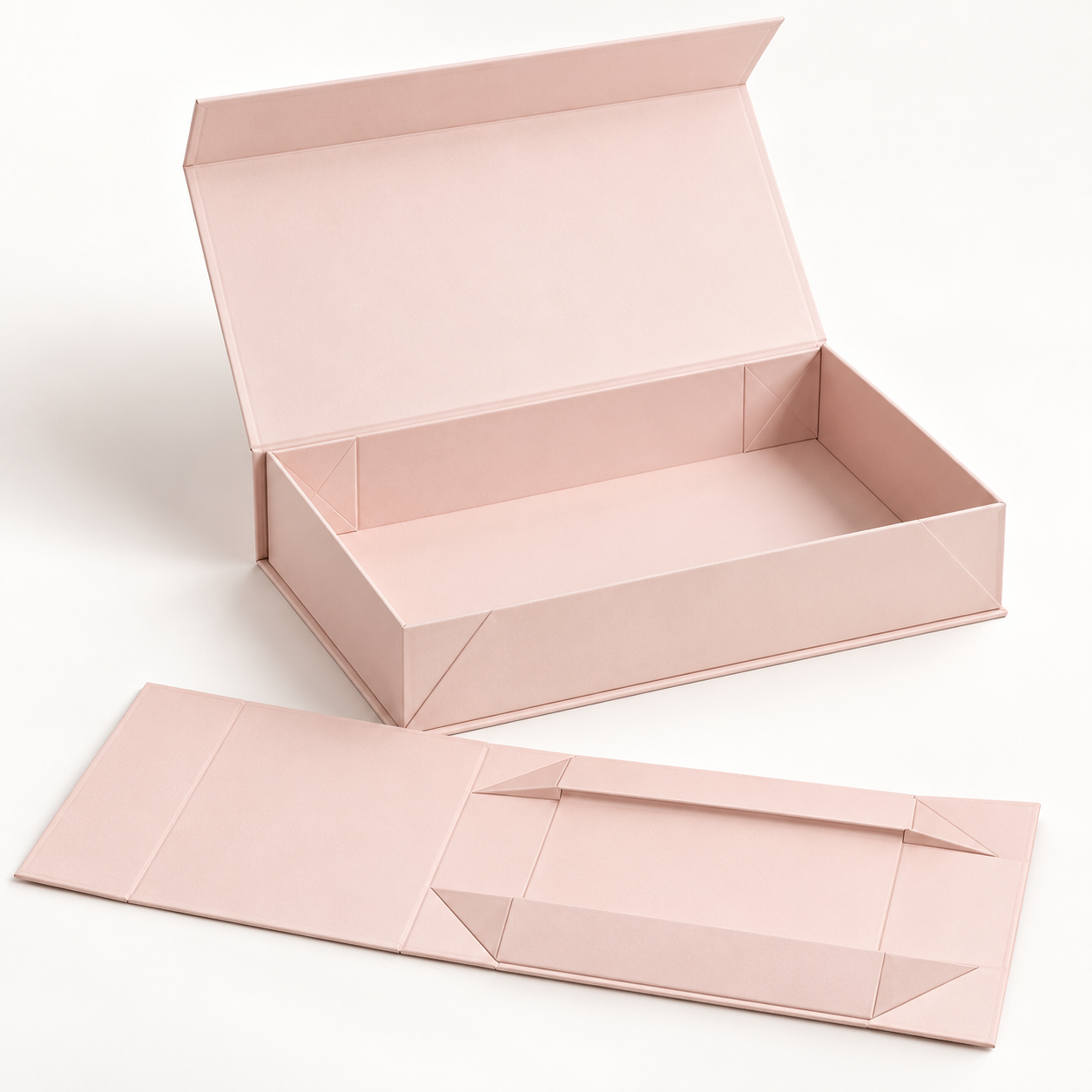


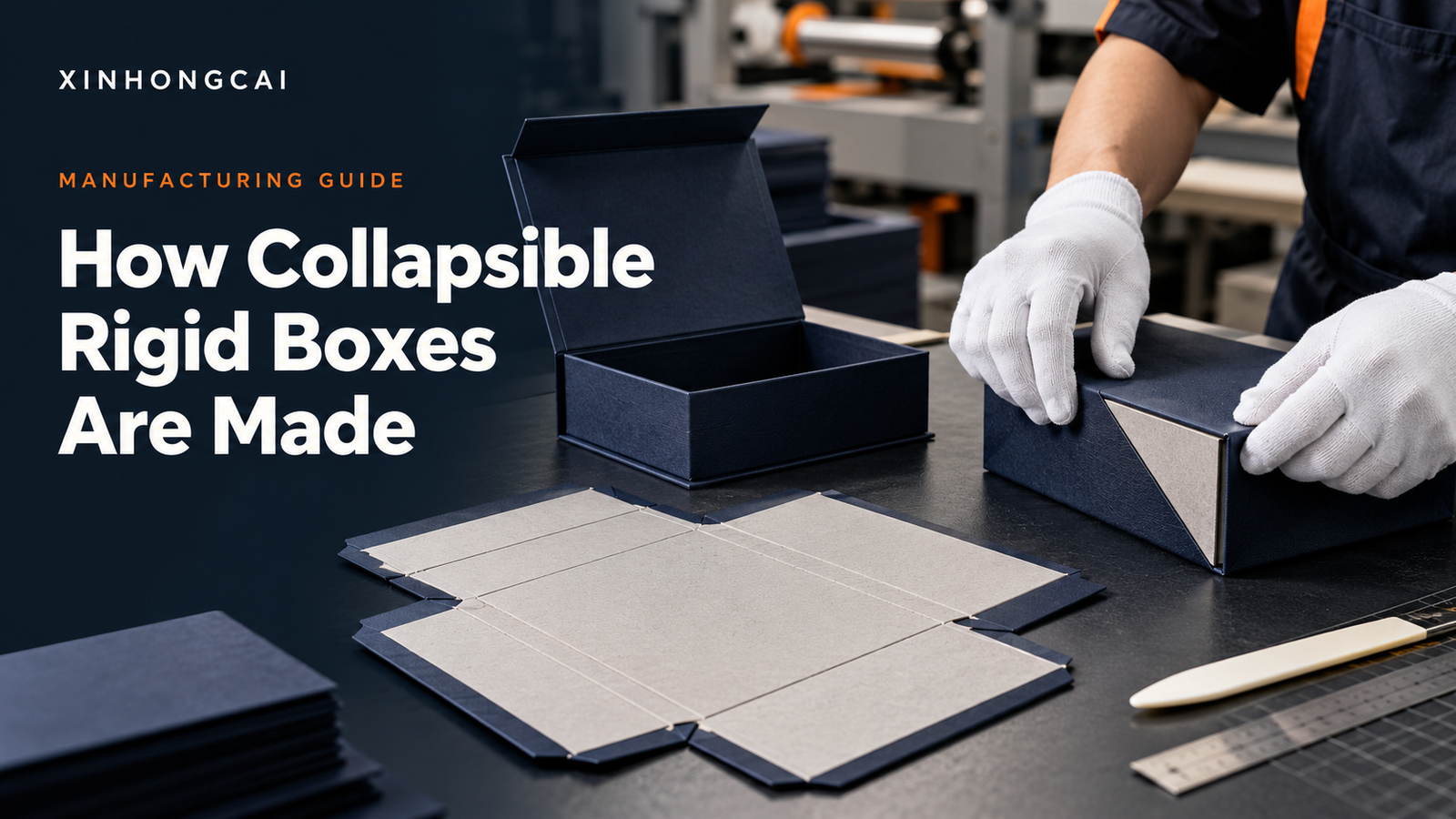
Collapsible rigid boxes are made in eight main steps: design and sampling, printing, finishing, die-cutting, board preparation, forming and wrapping, assembly of components, and inspection and flat-packing. Each step is checked before the next begins, so the approved sample becomes the standard for the whole production run.
Key takeaways
- A physical sample is approved before mass production begins.
- Printing and finishing happen on the wrap paper before it meets the board.
- Hinge lines and magnets are the critical points that make the box fold flat and close well.
- Quality checks run at incoming (IQC), in-process (IPQC) and outgoing (OQC) stages.
1. Design and sampling
We confirm internal size, structure (five-, six- or seven-panel, magnetic, handle), board thickness and artwork. A dieline is prepared and a white or printed sample is made for approval. Samples typically take 3 to 5 working days.
2. Printing
Artwork is printed on wrap paper, usually by offset printing with a computer-to-plate workflow for accurate color. Pantone matching is used for brand colors.
3. Finishing
Printed sheets receive lamination, hot-foil stamping, embossing or debossing, and spot UV as specified. These effects are added to the paper before wrapping so they stay crisp.

4. Die-cutting and board preparation
Paper is die-cut to shape and thick paperboard panels are cut and grooved. The groove lines become the hinges that let the box fold flat.

5. Forming and wrapping
Board panels are positioned on the printed paper and wrapped with adhesive, with edges turned in for clean corners. Panels are joined with hinge strips or wrapped folds to create the collapsible structure.
6. Assembly of components
Magnets, ribbons, windows, handles and inserts are added. Magnet placement is critical for lid alignment, so it is checked on every batch. See what buyers should know about magnetic boxes and our inserts guide.
7. Inspection and flat-packing
| Stage | Checks |
|---|---|
| IQC (incoming) | Board, paper, magnets and inserts against specs |
| IPQC (in-process) | Color, finishes, glue, corners, fold lines |
| OQC (outgoing) | Dimensions, appearance, open-close test, carton count |
Approved boxes are folded flat, bundled and cartoned for export. Read more on our quality control and automation and technology pages, or see why flat packing matters in shipping volume.
Frequently asked questions
How long does production take?
Typically 10 to 20 working days after sample approval, depending on quantity and finishes.
Are collapsible boxes made by hand or machine?
A combination. Printing, die-cutting and many forming steps are machine-assisted, while wrapping detail, magnets and inspection involve skilled hands.
How do you make sure each box matches the sample?
The approved sample is the reference, and IQC, IPQC and OQC checks compare production against it.
Which certifications does the factory hold?
ISO 9001, ISO 14001, FSC and amfori BSCI audit status. See our certifications page.
Can you add inserts and ribbons in the factory?
Yes. Inserts, ribbons and other components can be assembled before packing.
Request a Quote
Tell us about your project. Share your box style, size, materials and quantity, and our team will come back with a custom packaging quote.
Leave a Reply